
Rotor vs Spray Sprinklers: Which Pop-Up System is Right for Your Lawn?

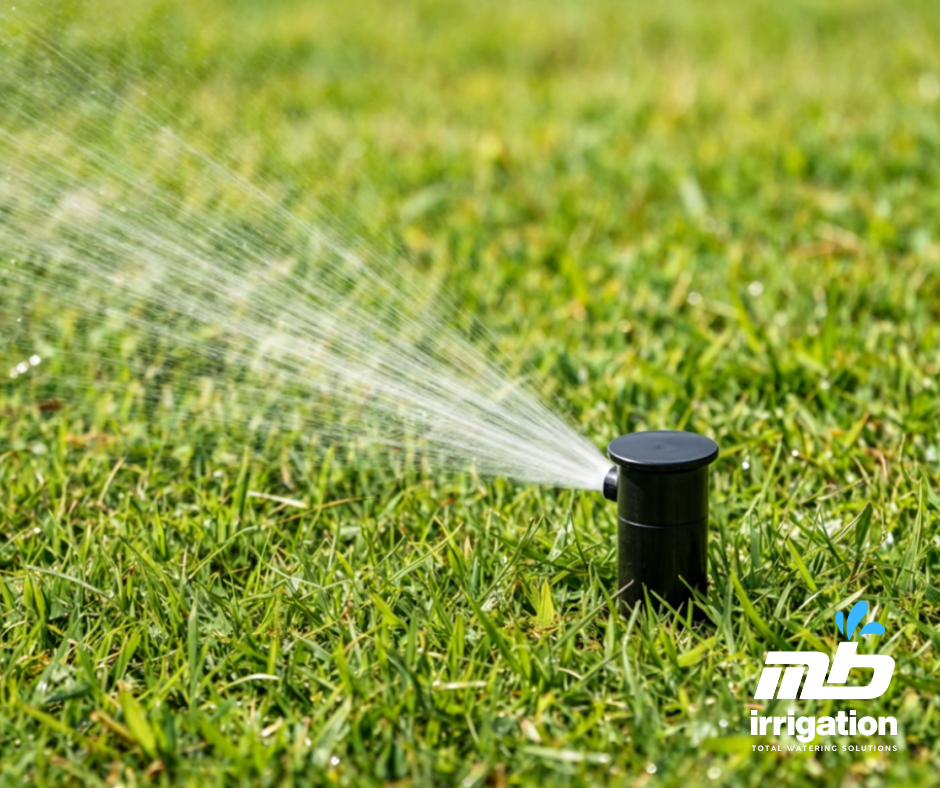
When you look at a beautifully manicured, emerald-green lawn in the height of British summer, you are almost certainly looking at the work of an automated underground watering grid. Pop-up sprinklers are the ultimate way to keep turf thriving without dragging hose pipes across the grass every evening. However, when you start browsing the catalog, you will notice two completely distinct families of hardware: gear-driven Rotors and static Sprays.
Mucking up the choice between these two types of pop-up bodies is a classic mistake that leaves hundreds of lawns with dry, brown patches and waterlogged corners. At MB Irrigation, we design and fit bespoke sprinkler systems every week around Cheshire. In this trade guide, we will break down the structural differences between rotor and spray sprinklers, explain how to match them to your garden’s shape, and reveal the golden rules of lawn irrigation layouts.
What are Gear-Driven Rotor Sprinklers?
Rotor sprinklers are the heavy-hitters of the turf watering world. Iconic models like the Hunter PGP, PGJ, or the Rain Bird 5004 series belong to this family. They operate by emitting a single, thick, high-pressure jet of water that slowly sweeps back and forth across a pre-set arc (typically adjustable from 40 to 360 degrees).
Because they concentrate all their water pressure into a single rotating stream, rotors can throw water over massive distances. They are specifically engineered for medium to large lawns, with throw radiuses stretching anywhere from 5 meters up to 15 meters or more. They also feature a slow application rate (precipitation rate), meaning the water has plenty of time to soak deeply into the root system without causing erosion or surface pooling on heavy clay soils.
What are Static Spray Sprinkler Bodies?
Static spray bodies, such as the legendary Rain Bird 1800 series or Hunter Pro-Spray lines, operate on a completely different principle. When water pressure hits a spray body, the riser emerges from the ground and instantly emits a flat, uniform umbrella fan of water across the entire zone all at once. There are no moving, rotating parts inside the body itself.
Sprays apply a large volume of water very quickly, which is fantastic for close-range, precise coverage. However, they lack the long-distance muscle of a rotor. Spray bodies are designed for small lawns, narrow grass verges, intricate flower borders, and curving garden paths where a long-distance jet would cause wasteful overspray onto your garden fence or patio. Their standard throw radius is tight, typically topping out between 2.5 and 5 meters.
The Golden Rules of Lawn Irrigation Design
To avoid a plumbing disaster under your turf, every professional installer in the UK adheres to these two strict design principles:
Rule 1: Never Mix Rotors and Sprays on the Same Zone
This is an absolute trade law. Because static sprays dump water onto the ground roughly three times faster than a gear-driven rotor, putting them on the same automated pipe loop will cause havoc. By the time the rotor has slowly circled around enough to give the grass a light soak, the area covered by the static spray will be completely flooded. Always separate your lawn into dedicated rotor zones and dedicated spray zones.
Rule 2: Aim for “Head-to-Head” Coverage
Many amatures assume that if a sprinkler’s stream can just about reach the edge of the next sprinkler, the lawn is covered. In reality, pop-up heads apply the least amount of water right next to their own nozzle. To get a perfectly uniform soak with zero dry spots, the spray stream from one sprinkler head must travel far enough to physically hit the body of the adjacent sprinkler. This is called **head-to-head coverage**, and it is crucial for combatting unpredictable UK breezes.
Protecting Your Investment Underground
No matter which system fits your property, remember that burying rigid plastic threads directly into the ground makes them vulnerable to snapping when heavy lawnmowers or foot traffic roll over the grass. Always mount your pop-up bodies to the lateral pipeline using flexible, articulated **Swing Joints**. These double-elbow swivels cushion sudden impacts, allowing the sprinkler body to safely sink down into the soil rather than cracking your main pipework threads.
Whether you are sketching out a new multi-zone pop-up sprinkler matrix or replacing old spray heads in Warrington, choosing the right hardware saves a massive amount of water and keeps your turf in peak condition. Browse our professional pop-up sprinklers catalog at MB Irrigation today for trade-grade parts, local Cheshire advice, and rapid UK delivery.