Hydraulic System Optimization

Hydraulic System Optimization
Friction Loss and Velocity
When designing or auditing an irrigation system, your primary goal is to deliver water at the correct pressure and flow rate to each emitter. The main obstacle is friction loss: the reduction in pressure as water moves through the LDPE piping and fittings. This loss is not linear; it’s influenced by the pipe’s length, its internal diameter, and the velocity of the water moving through it.
For precise calculations, the Hazen-Williams equation is a reliable tool. It provides a clear relationship between flow rate, pipe characteristics, and the resulting head loss (a measure of pressure reduction).
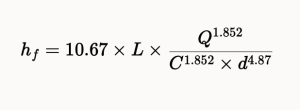
This formula calculates the head loss due to friction () in metres.
- L is the length of the pipe in metres.
- Q is the flow rate in cubic metres per second.
- C is the Hazen-Williams friction coefficient, which represents the pipe’s smoothness. For new, smooth LDPE, this value is typically 150.
- d is the internal diameter of the pipe in metres.
The C-factor is critical. While new LDPE has a high C-factor, it degrades over time due to slime buildup and abrasion, increasing friction loss. It’s wise to use a slightly lower C-factor, like 140, in your calculations to account for future system performance.
Friction loss is directly tied to water velocity. As you push more water through a pipe of a given size, the velocity increases, and friction loss rises exponentially. For LDPE pipe, it is essential to keep the water velocity below 1.5 metres per second. Exceeding this limit dramatically increases pressure loss, puts mechanical stress on the pipe and fittings, and significantly raises the risk of water hammer.
Static vs. Dynamic Pressure
Understanding the interplay between static and dynamic pressure is key to optimising a system. Static pressure is the pressure within the system when no water is flowing. It represents the maximum potential pressure, determined by the source (e.g., a pump or municipal main) and any changes in elevation.
Dynamic pressure, or operating pressure, is the pressure when the system is running. It’s the static pressure minus all the pressure losses, primarily from friction (hf) and elevation gains. This is the pressure that the drippers and sprinklers actually experience.
An efficient system maintains sufficient dynamic pressure to operate the furthest emitters correctly without subjecting the closest emitters to excessive force that causes misting, soil erosion, and wasted water.
The goal is to find a balance. If the static pressure is too low, the dynamic pressure at the end of a zone may be insufficient after accounting for friction loss. If it’s too high, you risk damaging components and creating inefficiency. This is where pressure regulation becomes indispensable. Pressure regulators, either for an entire zone or on individual emitters, ensure a constant, optimal output pressure regardless of fluctuations in the dynamic pressure within the pipe.
Water Hammer and System Fatigue
System fatigue refers to the cumulative wear and tear on pipes, fittings, and valves. A primary cause of this fatigue is water hammer, a hydraulic shockwave that occurs when the flow of water is stopped or changed abruptly. When a solenoid valve snaps shut, the moving column of water crashes into it, creating a momentary but intense pressure spike that travels back through the pipes.
This shockwave can rupture pipes, break fittings, and damage valves and sprinklers over time. The risk is highest in systems with high water velocities (above 1.5 m/s) and fast-closing valves.
Mitigating water hammer involves several strategies. First and foremost, adhere to the velocity limit by correctly sizing your pipes for the required flow rate. You can also install water hammer arrestors, which are small devices containing a pocket of air or a spring-loaded piston that absorbs the pressure spike. Using ‘soft-closing’ solenoid valves, which shut off the water flow more gradually, is also an effective solution for preventing the shockwave from forming in the first place.
By actively managing friction loss, balancing dynamic pressure, and mitigating water hammer, you ensure the long-term health and efficiency of the irrigation system, preventing premature failure and guaranteeing precise water delivery.